The Sorensen Monologues
Better call Police-Pal Prosecutor
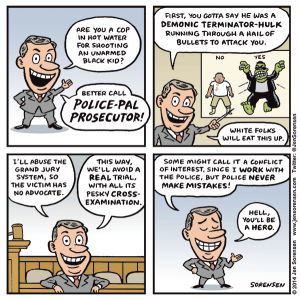
To me, the most questionable parts of Officer Darren Wilson’s testimony were his over-the-top descriptions of Michael Brown. According to Wilson, Brown “had the most intense, aggressive face I’ve ever seen on a person. The only way I can describe it, it looks like a demon. That’s how angry he looked.” Wilson also says, “At this point it looked like he was almost bulking up to run through the shots.”
Now, I didn’t know Michael Brown personally. But Brown had several bullets in his body before Wilson fired the fatal shot, and the kid was stoned. How fast could he possibly have been moving? Witnesses are all over the map on this one.
I don’t doubt that Darren Wilson was afraid. I think he freaked out and used excessive force. In his retelling — and most likely in his own mind as events were unfolding — he turned Brown into a cartoon character, a CGI-enhanced Hollywood supervillain.
A public trial might have shed further light on the case, but thanks to Prosecutor McCulloch’s refusal to recuse himself due to his obvious conflict of interest, it looks like true justice will not be served. More on his misuse of the grand jury process here.
Grandpa Perkins’ Thanksgiving Tirade

Everything about the Ferguson decision was bad, including the timing of the announcement, which came just after my cartoon deadline. But you wanted to hear what Grandpa Perkins has to say anyway.
Many people have the feeling that the country has seen better days, that we’ve lost our small town roots and values. But instead of looking to factors like corporate chains replacing local businesses, the spread of low-paying jobs, sprawl, and the sucking sound of Wall Street hoovering up the nation’s wealth, millions of Americans have been led to believe that immigrants are to blame. Then they do their shopping at places like Walmart and the cycle continues.
Life in the Billionaire Bubble

The billionaire in question is one Paul Singer, who wrote an epic screed to his investors about the “fake” economic numbers coming out of Washington. Singer issued the following caveat:
check out London, Manhattan, Aspen and East Hampton real estate prices, as well as high-end art prices, to see what the leading edge of hyperinflation could look like
Now, it seems to me that other factors may be coming into play here. For example, when 1% of the world’s population holds as much wealth as the bottom half, you’re going to see some pressure on those Picasso price points. It’s a clash of the titans — titans with near-infinite resources to spend impressing each other to death!
When you see the price of luxury homes as a more reliable indicator of inflation than the price of milk or gas — or government data showing that inflation is under control — it says more about your limited, paranoid perspective than anything else.
Low-information Nation: Midterm Elections Edition
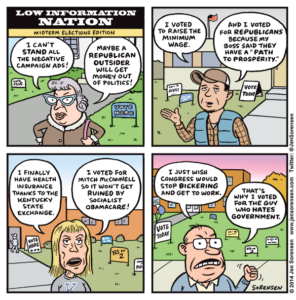
A couple articles inspired this cartoon. First, this piece from September, about Kentucky voters who love the state’s new health insurance exchange (Kynect) but still disapprove of the Affordable Care act:
“I’m tickled to death with it,” Ms. Evans, 49, said of her new coverage as she walked around the Kentucky State Fair recently with her daughter, who also qualified for Medicaid under the law. “It’s helped me out a bunch.”But Ms. Evans scowled at the mention of President Obama — “Nobody don’t care for nobody no more, and I think he’s got a lot to do with that,” she explained — and said she would vote this fall for Senator Mitch McConnell, the Kentucky Republican and minority leader, who is fond of saying the health care law should be “pulled out root and branch.”
Then there was this piece about disillusionment with Washington last Wednesday. It was full of quotes by people angry about gridlock, but not quite grasping its source:
And in Racine, Wis., Jeffrey Kowalczuk, a 56-year-old account representative for a trucking company, seemed no less disillusioned than Ms. Pizarro after voting for Republicans in that critical state. “I’m just tired of all the fighting and bickering,” he said. “We’re all Americans. It’s just getting old with all that stuff.”
That would be from a man who ostensibly voted for SCOTT WALKER. The article concluded:
“Obama has not accomplished what he promised to the community,” said Juan Neyra, 69, a retired security guard in Denver. He said he used to vote for Democrats, but this year had voted for the Republican Senate candidate, Representative Cory Gardner, who was challenging Senator Mark Udall, a Democrat. “And Udall supports Obama,” Mr. Neyra said.
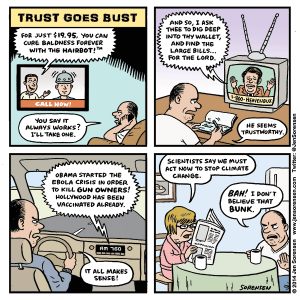
Straight outta the GOP playbook.
Desperation Nation
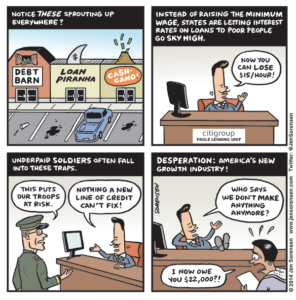
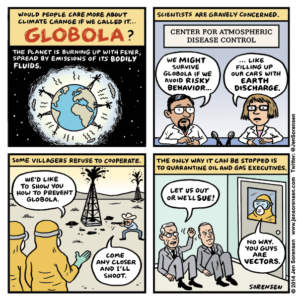
Something’s going up for people struggling financially — and it’s not the minimum wage. The low-end consumer loan business is booming, with several states caving in to lobbyists’ efforts to let interest rates go even higher.
America of the Future
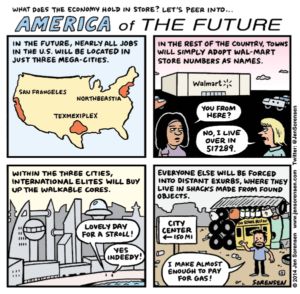
I spend a lot of time thinking about the problems outlined in this cartoon. Concentrating prosperity into just a few ever-growing cities seems ridiculous and unsustainable. Having just traveled from Austin to San Francisco and back, it’s interesting to compare how this dynamic is playing out in both places. At least SF has the BART. But in both of these tech hubs, affordable housing is being pushed farther and farther out — and not everyone wants to be a commuter.
Related reading: James Howard Kunstler’s The Geography of Nowhere.
The GOP’s Fight Against Early Voting Explained
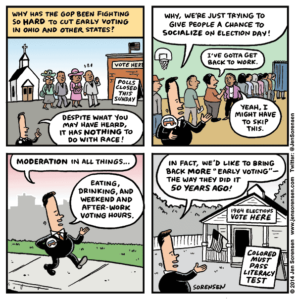
Somewhat buried in the news last week, amidst stories about Ebola and ISIS, was the Supreme Court’s 5-4 ruling on Ohio’s early voting period. The predictable majority sided with Ohio’s Republican Secretary of State Jon Husted, allowing him to delay early voting by a week. This first week is known as the “Golden Week” because people can still register to vote in the same period. The extreme Supremes reversed the rulings of lower courts that sided with plaintiffs who claimed this will disproportionately affect African-American voters, many of whom take advantage of early voting.
Ohio officials have failed to offer a compelling reason why the cutbacks in early voting are so important. Why would they spend so much effort on this, taking the fight all the way to the Supreme Court? Two year ago, The Nation reported on a moment of candor from a GOP elections official:
Franklin County (Columbus) GOP Chair Doug Preisse gave a surprisingly blunt answer to the Columbus Dispatch on Sunday: “I guess I really actually feel we shouldn’t contort the voting process to accommodate the urban—read African-American—voter-turnout machine.” Preisse is not some rogue operative but the chairman of the Republican Party in Ohio’s second-largest county and a close adviser to Ohio Governor John Kasich.
Maybe we should take a cue from the protesters in Hong Kong clamoring for democracy and express more outrage at what’s happening to our own.
March of Doom
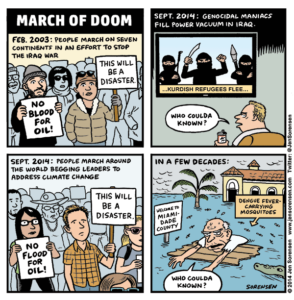
Seeing the People’s Climate March reminded me of the global protests against the Iraq War in 2003. People protested on every continent, including Antarctica, in an effort to stop the invasion. It was a rare feat of organization and international unity — and it was largely ignored. I drew a cartoon at the time pointing out that heavy snowstorms received more prominent coverage on the front page of the Washington Post than the protests.
When I see ISIS rampaging through Iraq and Syria, butchering people and displacing families, I think about how intelligent people around the world did everything they could to prevent the colossal humanitarian disaster of the past eleven years that is still unfolding. I think protesting is our ethical obligation, but the sense of coming up against an immutable force is familiar.
Alternate strip titles included: “History Re-heats Itself”; “Between Iraq and a Hot Place”; and “Worst Learning Curve Ever.”
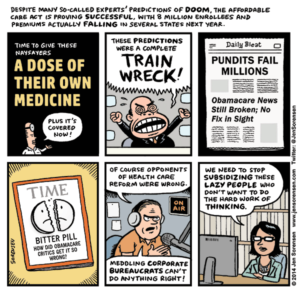
SPX 2014 Photos
I was humbled to be included in this photo of a rare multi-generational gathering of alt-weekly cartoonists (click to enlarge):
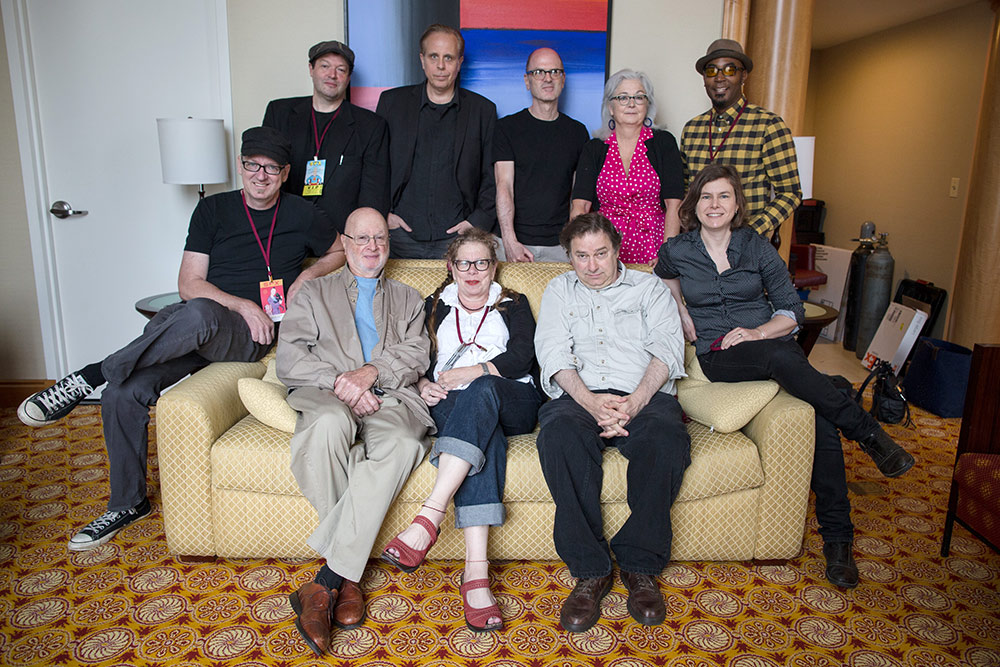
Clockwise from left: Derf, Shannon Wheeler, Tom Tomorrow, Charles Burns, Mimi Pond, Keith Knight, me, Ben Katchor, Lynda Barry, Jules Feiffer
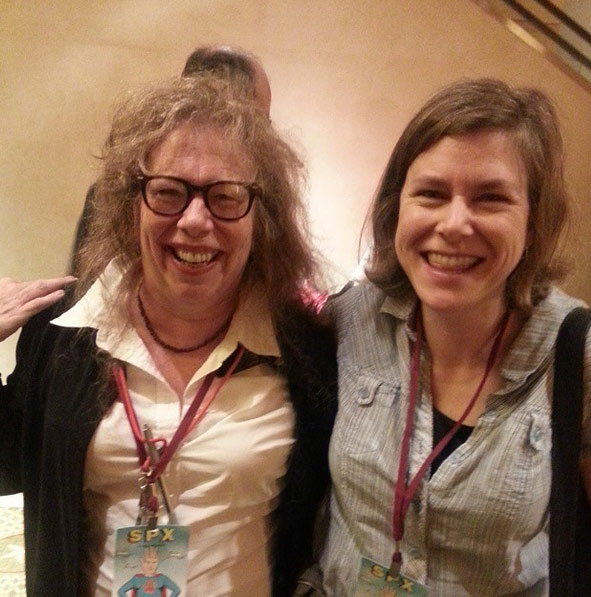
Here’s a nice shot of Lynda Barry and me laughing at the fact that my phone started taking a million pictures of us. Next in the sequence is me holding out my hand and saying “STOP!” (not shown).