
The Sorensen Monologues
Delayed posting + WaPo article
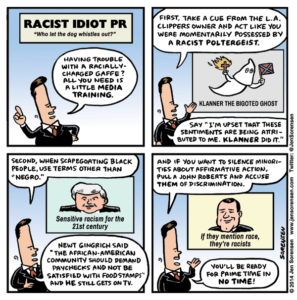
I had a whirlwind of a week in DC for the Herblock ceremony, and did not get around to posting the latest cartoon on Monday as usual. Fortunately(?), Donald Sterling is still making headlines by putting his foot in his mouth.
Also, be sure to check out this truly wonderful Washington Post article by Michael Cavna that was published the day of the Herblock event.
Society of Professional Journalists Award
Well, I’m having a good year. I’ve been named a winner of the SPJ’s Sigma Delta Chi Award, along with my colleague Angelo Lopez. Angelo is a talented cartoonist, and I encourage you to check out his work.
Let’s Talk About Checks

The Paycheck Fairness Act, recently torpedoed in the Senate, addressed some glaring problems that have generated less discussion than they should. This useful post (“Why Do Bosses Want Their Employees’ Salaries to be Secret?”) by Michelle Chen on The Nation explains the need for protections for workers who discuss their salaries:
Lily Ledbetter had been a loyal employee of Goodyear Tires for nearly two decades before she discovered she had been underpaid for years. What angered her most wasn’t the lost pay but the betrayal of her economic dignity.“When I was hired they let me know that if I discussed my pay, I wouldn’t have a job. So I had no way to know,” she said in a 2012 interview on One Thing New. When the 60-year-old Alabama mother realized (thanks to an anonymous tip) that she had been paid less as a plant supervisor than male coworkers, she recalled, “I felt devastated. Humiliated…. It just really made me sort of sick that all this time I had been getting awards and being told I was doing a great job, and no one had ever said I wasn’t making what I should be. I had no idea how much less.”
…
The struggle for fair pay isn’t captured in wage statistics; it’s part of a struggle against the asymmetry of knowledge that divides management and labor—and fundamentally, a struggle for a democratic workplace.
Well-said, and remarkable that so many Americans accept this asymmetry so unquestioningly.
The National Women’s Law Center has a handy PDF about what the Paycheck Fairness Act would actually do.
Tyranny of the Collectivists
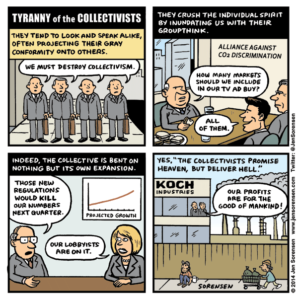
The “collectivists promise heaven, but deliver hell” quote is taken from that recent Charles Koch editorial in the Wall Street Journal. It’s time to think outside the Cold War box and consider the threat posed by corporate collectivism against the individual.
Get Your Words’ Worth
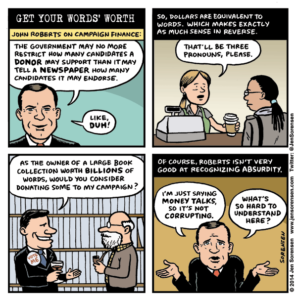
There were so many mind-blowingly illogical quotes in Roberts’ McCutcheon v. FEC opinion, it was hard to pick just one for the cartoon. Another classic:
“[Many people] would be delighted to see fewer television commercials touting a candidate’s accomplishments or disparaging an opponent’s character,” he wrote. “Money in politics may at times seem repugnant to some, but so, too, does much of what the First Amendment vigorously protects. If the First Amendment protects flag burning, funeral protests and Nazi parades — despite the profound offense such spectacles cause — it surely protects political campaign speech despite popular opposition.”
Way to confuse the content of the political ads, which no one is objecting to on free speech grounds, with how they are funded!
Additional thoughts on Obamacare comic
I’ve appended some follow-up thoughts on my Kaiser Health News comic to this week’s cartoon, below. (Posting this to cycle it into the blog section of the front page).
Obamacare 101 with Professor P
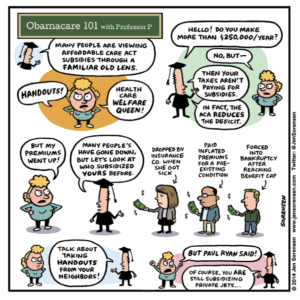
While I’ve received many encouraging comments on my recent comic for Kaiser Health News (“My Experience With Obamacare”), I’ve been struck by certain accusations that suggest widespread misinformation about how the Affordable Care Act actually works.
Clearly there’s a massive effort on the right to paint the ACA as a big, bad welfare program that’s transferring money from hardworking folks to undeserving scapegoats of some sort. Indeed, this seems to be the only lens through which many conservatives seem capable of looking at the world. (Not that I don’t support a strong social safety net.)
Here’s how the funding of ACA subsidies actually works: The cost is covered by a combination of cuts to Medicare overpayments to private insurers, cuts to the growth rate of Medicare reimbursement to hospitals, taxes on companies that stand to benefit from the ACA (such as medical device makers and insurance companies), and a tax increase on the top 2%. More info here and here.
So, unless your household is making approximately $250,000 a year, your tax dollars are not marked for the subsidy program. Note that federal income taxes for the rest of us have not gone up.
For the record, I pay a lot of money in taxes, from the federal income tax to the double payroll taxes faced by freelancers on their Schedule C income (both the employer and employee portion), sales taxes of 8.25%, and Austin’s very steep property taxes. I’m funding public schools even though I have no kids, which is something I don’t mind doing. I’m also funding plenty of things I don’t support – drone warfare being one example.
I do empathize with those people stuck with premium increases they can’t afford. This seems to be partly a function of the high cost of living in certain places — another complication from America’s soaring economic inequality. But I wonder how many of the people complaining about their premiums (and shaming those of us who qualified for tax credits) supported the public option when it was on the table. A single-payer system is a far more efficient way of providing insurance – it’s what I’ve always supported, and would prefer. As far as I’m concerned, there’s no need for private health insurance companies to exist at all; they are bureaucratic middlemen whose profitability runs contrary to the job they are supposed to do.
I have to admit, though, that I’m kind of enjoying the spluttering of wingnuts who pose as champions of entrepreneurship, risk-taking, and rugged individualism, as they tie themselves into knots opposing a law that frees people to pursue those very activities. Some of them are even trying to cast people like me as irresponsible, erroneously suggesting that those who get insurance through their employer are somehow subsidizing those of us who work for ourselves.
It’s more like the other way around. In addition to the double payroll taxes enjoyed by the self-employed, we don’t receive health care benefits tax-free the way employees of a company do. This is a subsidy for the traditionally employed. We can take a deduction for our premium payments, but the income we use to pay them is still subject to taxes. The ACA is a step toward making the individual market more like a company insurance pool.
Here’s a great article about other subsidies enjoyed by many critics of the ACA.
Yes, Obamacare is an imperfect solution to an enormous health crisis plaguing the richest nation in the world, but don’t blame the guy who actually tried to do something about it. Instead of hurling invectives at those of us who finally have some peace of mind after agonizing over health insurance for years, why not focus your ire on extreme price-gouging by hospitals — $137 for a $1.00 IV drip bag, anyone?
In short, if you’re not making over $250,000 and you’re spewing this “I’m subsidizing you” nonsense, kindly put a sock in it. If your premiums went up, I’m sorry — but others were subsidizing them before, sometimes with their lives. If you are making over $250,000, you should support a program that makes America a fairer and better country. It’s a clear step in the right direction, if not the perfect solution.
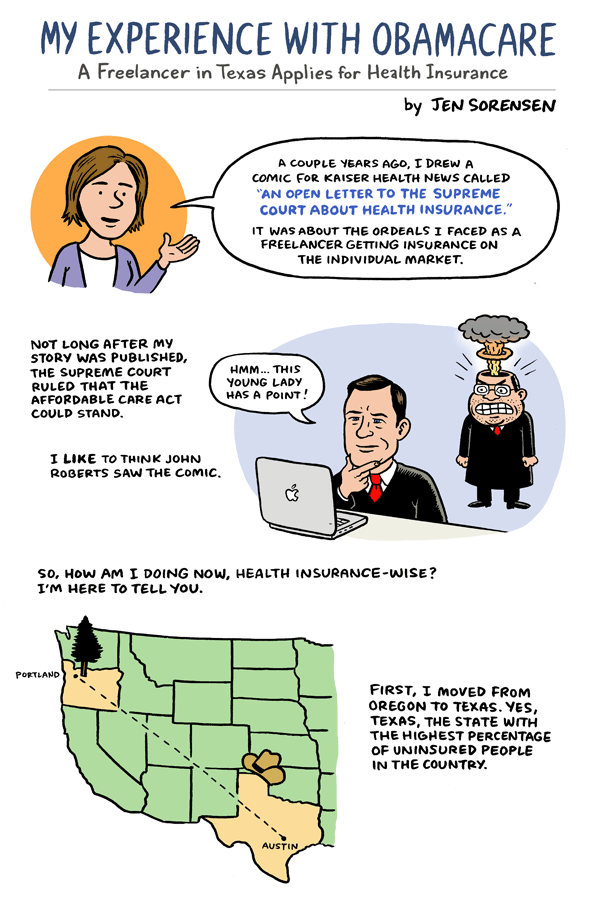
My Experience With Obamacare: Comic for Kaiser Health News
I’ve drawn a follow-up to my earlier comic for Kaiser Health News about being a freelancer in search of decent health insurance. This one is about my experience getting covered through the Affodable Care Act.
The NRA interviews Surgeon General Candidates
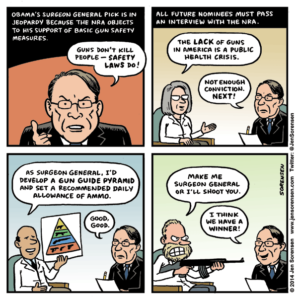
You know your country has gone off the deep end when a Surgeon General nominee encounters fierce political opposition because of this:
On the local level, the NRA has tried to bar pediatricians from counseling parents about the risks of keeping guns at home. The American Association of Pediatrics recommends that doctors begin to talk to parents about gun safety even before their baby is born and continue the conversation yearly, just as doctors talk to parents about the dangers of swimming pools and the importance of bicycle helmets. Florida passed a gag law in 2011; crafted by an NRA lobbyist, the bill forbids doctors from “making written inquiry or asking questions concerning the ownership of a firearm or ammunition by the patient or by a family member of the patient.” A district court ruled the following year that the law restricted physicians’ rights to free speech and the case is now in the appeals process. Murthy’s opposition to pediatrician gag laws was one of the reasons cited by the NRA and Rand Paul in their attempt to disqualify him.
TV Appearance on Fusion Network
I recently appeared on Open Source with Leon Krauze to discuss America’s extreme economic inequality. The show is on the Fusion Network, a new cable channel from ABC News and Univision.
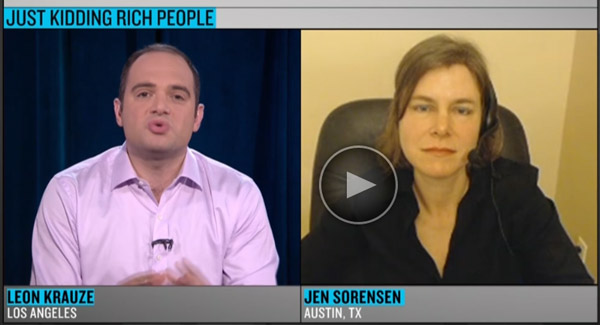
Political cartoonists are rarely interviewed on TV, which is strange when you consider how frequently opinion columnists or obscure academic authors make appearances as talking heads. Thanks to Fusion for having me as a guest.
No Fly List comic for ACLU
One of the projects I’ve been working on is an comic for the ACLU about innocent people trapped on the No Fly List. 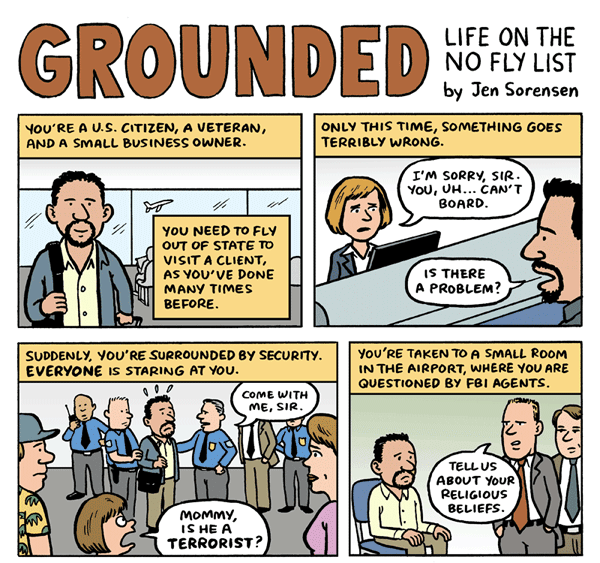
(Click to read the whole story on the ACLU website)
Working on this story (based on actual client testimony) was a real eye-opener. As things stand now, these people have alarmingly little recourse to clear their names.
Oral arguments in the ACLU’s lawsuit Latif v. Holder took place this week in Portland, OR.