The Sorensen Monologues
Progressive Kristallnacht
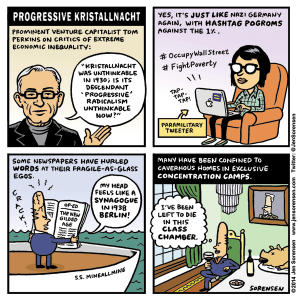
Some people make it easy. Tom Perkins’ letter in the Wall Street Journal comparing those who criticize America’s vast wealth gap to Nazis was over the top, but emblematic of a broader sentiment among certain plutocratic types. See this David Sirota article on Pando for other examples.
As I’ve said before, it’s not that I “hate the rich” — it’s the system that’s slouching toward aristocracy that bugs me.
For a little more background on Mr. Perkins (the person, not my cartoon character of the same name), this Wall Street Journal post sheds some light. The Maltese Falcon has since been sold.
Recommended viewing on the so-called moochers
Those who blame poverty on poor people not trying hard enough (and even those who don’t) should watch the Frontline documentary “Poor Kids” about the kids in a few struggling families in the Midwest. I finally got around to watching it myself last night, something I’ve been meaning to do since it was named the winner of a 2013 RFK Journalism Award for Domestic TV. Warning: will make you realize everything is worse than you thought.
Nation of Moochers
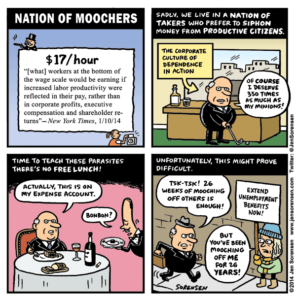
Here’s the NYT editorial I quoted in the first panel.
This cartoon was partly inspired by this amazing Fox News graphic that was ridiculed on the Daily Show the other night:
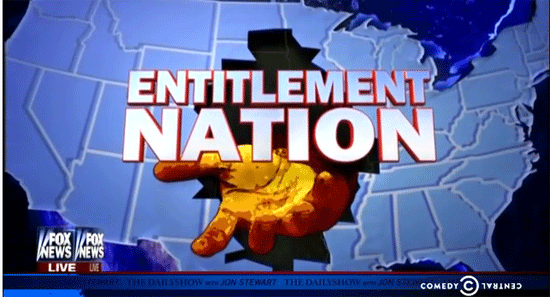
The above confirms my belief that we need to call the social safety net something other than “entitlements.” The word, while technically correct, has been hopelessly conflated with “sense of entitlement” by those with a pro-1% agenda.
Hangin’ with the Fed
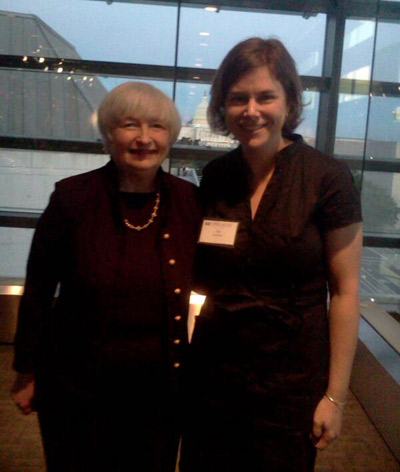
I was happy to learn this week that Janet Yellen has been confirmed as the first female Fed Chair in U.S. history. One of the highlights of last year for me was getting to meet Yellen in person. I was at the RFK Journalism Awards in Washington DC last September, and I noted to a friend sitting next to me that the Book Award winner, Joseph Stiglitz, had recently penned an excellent op-ed in support of Yellen. No sooner had the words escaped my mouth than I turned around to discover Yellen herself sitting in the row behind me. After doing a double-take, I introduced myself, explaining that I had drawn an editorial cartoon supporting her nomination. As it turned out, she had seen it. Both she and her husband, Nobel Prize-winning economist George Akerlof, were very gracious.
I appear tallish in this photo, but in fact I’m only a bit over 5’5″.
Newish Gigs
Some exciting new developments: As of a couple months ago, The Nation began publishing comics regularly in the print edition, as well as online, and I’m honored to be in the rotation. Here’s a recent strip of mine in Comix Nation.
I’m also happy to be part of Medium.com’s stellar new cartoon lineup, which you can check out here. My strip will appear on The Nib on Thursdays.
Cartoon flashback: World’s Scientists Flummoxed by Snowstorm
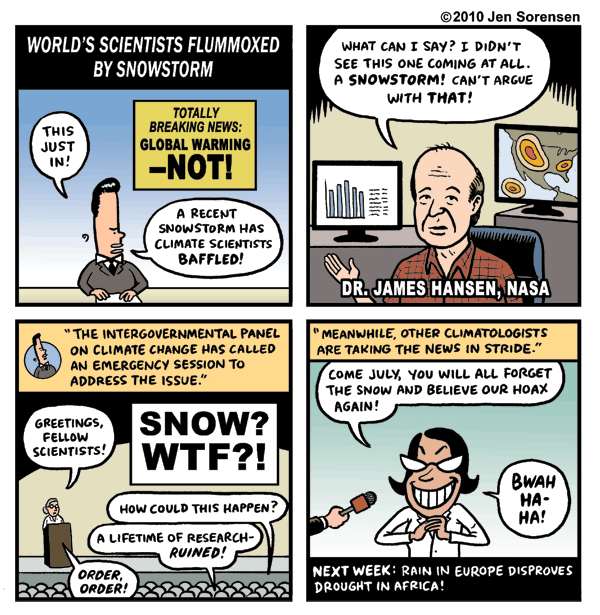
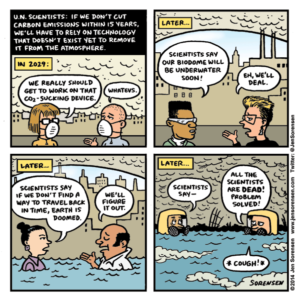
Ah, it’s that time of year: Snowstorms and cold weather inspire a flurry of bad editorial cartoons questioning the science of global warming since, you know, it’s really cold out. To honor the occasion, I’m sharing a strip I drew a few years ago as a reaction to those terrible cartoons.
A few readers failed to detect the snark in this one, and wrote me very angry emails attempting to explain how climate change worked. So please be sure to wear your sarcasm hat.
Know Your Potheads
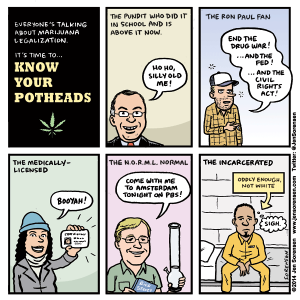
In his much-discussed column last week, David Brooks admitted to getting stoned in high school, but dismissed legalization, calling for a government that “subtly encourages the highest pleasures, like enjoying the arts or being in nature” and discourages people from getting stoned. I’m all for government that extols the virtues of the arts and nature, but decriminalizing pot is hardly tantamount to encouraging people to smoke it.
Blacks are four times as likely as whites to be arrested for marijuana, even though usage falls evenly across different racial demographics. As travel-guide author and TV personality Rick Steves points out in his statement on the NORML site:
“Last year over 750,000 Americans were arrested on marijuana charges. Many of them were sentenced to mandatory prison time. Our courts and prisons are clogged with non-violent people whose only offense is smoking, buying or selling marijuana. While our nation is in a serious financial crisis, it spends literally billions of dollar annually chasing down responsible adults who are good, tax-paying citizens in all regards except for the occasional use of marijuana.”
Job Advice With Rand Paul
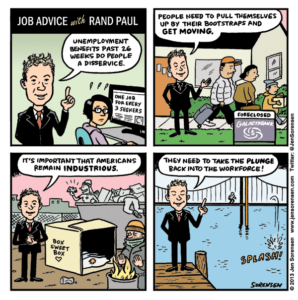
Recommended reading: this Ezra Klein post about the reality of unemployment in America today. The national average may be three job seekers for every job opening, but for many people it’s worse than that:
“Nationally, there are three job seekers for every one open position. But because unemployment is much higher in some cities than in others, the reality is that most people who’ve been unemployed for more than 26 weeks live in areas where there are four, five, six, seven and even eight job seekers for each open job. They’re not being held back by their unemployment checks. They’re being held back by mass unemployment.”
But apparently the facts on the ground don’t matter for someone with his head stuck in dense clouds of libertarian dogma.

Centennial, Colorado requests anonymity for school shooter; I agree
Families and officials in Centennial, Colorado, the scene of the latest school shooting, have been taking a subdued approach to discussing the identity of the shooter, requesting that the media not name him or show his picture. I wholeheartedly agree. I have long maintained that extensive coverage of the shooters themselves is unnecessary and contributes to the problem.
Some members of the media bristle at this; it smacks of censorship, they claim. It prevents us from understanding why the shooting happened. But mass shootings are media phenomena; the media is part of the story. It’s not just a passive vessel for static facts. We can understand what led to a mass shooting without the exhaustive, titillating exploration of every detail of the killers’ lives. Moreover, this sort of sensational coverage of the shooter himself leads us to believe it’s an individual problem as opposed to systemic. I would argue it gets us farther from the truth.
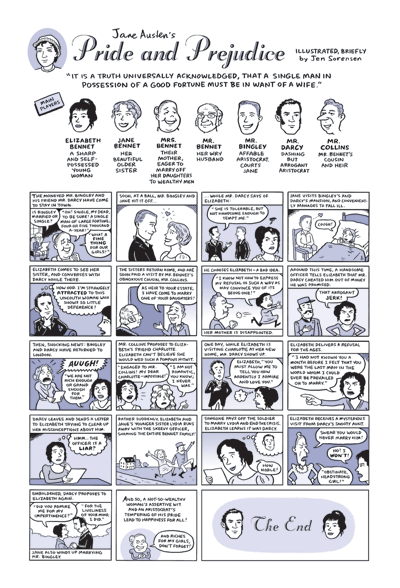
Pride and Prejudice Posters now available!
For the 200th anniversary of Jane Austen’s Pride and Prejudice earlier this year, NPR Books asked me to create a one-page comic version of the story. This was something of an artistic challenge, but in the end it seemed to please Jane Austen fans and scholars, who made it the most-read story on NPR that day.
And lo, just in time for last-minute Christmas shopping (or in plenty of time for the 201st anniversary of Pride and Prejudice), I have prepared for you a lovely poster version of the comic, available hand-signed. The printer did an excellent job; the poster is on heavy stock with a smooth, silky finish that you’ll want to caress as Jane would Mr. Bingley.